The Office as a Service: Why Workspace Is the New Cloud Spend
Twenty years ago, IT moved from owned infrastructure to on-demand services and never looked back. Workspace is now on the same trajectory. Discover why the office is becoming the new cloud spend, what “ghost space” and “shadow workspaces” are costing you, and how leaders can build a workspace cloud model with full visibility, governance, and on-demand scalability.


There's a moment in every company's lifecycle when a line item stops making sense.
In the early 2000s, that moment arrived for IT infrastructure. Back then, companies used "on-premises" computing infrastructure, meaning all IT systems like servers, storage, networking, and software were physically located. Corporations bought, owned, and maintained physical servers and equipment and housed them in their offices or data centers. It was expensive, fixed, and massively overbuilt even for peak demand.
The model was: you bought capacity upfront, maintained it constantly, and paid for it whether you used it or not.
Fast forward to the 2020s, and the similarities between the server and the office are striking. Organizations are signing long leases with high upfront build-out costs. This gives them fixed capacity based on headcount assumptions. Ongoing costs like rent, utilities, and maintenance don't change regardless of how full the office is. And by 2025, average peak office utilization in the US only came to 25%, meaning at the busiest moment of the week, three-quarters of office space went unused.
Companies are effectively paying for office infrastructure that runs at a fraction of its capacity, just as they once did with underutilized servers.
This comes against a backdrop of seismic shifts in the way work actually happens. Work is now distributed, asynchronous, and unpredictable. Teams form and dissolve around projects. Attendance fluctuates weekly and even daily. Employees move between home, office, and third spaces depending on the task. Demand for workspace hasn't disappeared, but it has become intensely variable.
These are exactly the conditions that gave rise to cloud computing. Business leaders started asking, "Why are we paying this much for something we use this little?" Faced with variability, instead of owning fixed IT infrastructure, companies decided to move to on-demand models for computing. This meant paying only for what they used, scaling up or down as needed, and converting capital expenditure into operational spend.
This shift wasn't just a financial rewiring, it rewrote an entire industry. The cloud was born. SaaS took over. Owning your own servers went from "best practice" to archaic overnight, as software-as-a-service brought unparalleled visibility, flexibility, and control.
Workspace is undergoing the same transformation as IT: from fixed physical infrastructure to on-demand consumption. The rise of flexible office models like coworking memberships and distributed hubs is an early signal. The global flexible office market was valued at $45 billion in 2025 and is projected to grow to a staggering $195 billion by 2034. At the same time, around 50% of large global firms are expecting to reduce their office space. This plots a clear path: workspace isn't being procured as a permanent physical asset, but instead as a variable, on-demand service.
Traditional corporate HQs, much like the server rooms of the past, are being replaced by an elastic workspace layer that can scale up or down based on the real-time requirements of a distributed workforce - just like cloud computing.
The difference is that, unlike in IT, most companies haven't built the systems to manage it yet. Too many are stuck on the precipice of this shift, without the tools to take full advantage. Join us for our expert guide to what the cloud spend revolution in IT can teach us about workspace today.
Is your workspace running like an on-premises server room?
See how Croissant brings the cloud spend playbook to your office footprint.

What the Cloud Spend Transformation Got Right
The success of cloud transformation wasn't down to a change in pricing model, but how it unlocked a completely new operating model.
Before software as a service took hold, companies bought perpetual software licenses with large upfront CapEx commitments, then spent up to five times that amount on implementation, customization, and deployment. Projects routinely ran over budget, timelines slipped by months, and once everything was finally live, a dedicated team was required just to keep the system running.
Companies committed early, overbuilt for an uncertain but ambitious future, and then spent years maintaining infrastructure that didn't match how they actually operated.
Until everything changed. Companies like Salesforce reframed the software question from "how do we own software more efficiently?" to "why do we own software at all?" With the rise of Amazon Web Services and browser-based applications, companies no longer needed to buy and maintain physical servers, provision data centers, or plan years in advance for peak capacity.
Instead of racking servers in climate-controlled rooms, installing software manually on individual machines, and running dedicated IT teams to manage uptime, security patches, and storage limits, companies could simply access software over the internet. Compute, storage, and applications became services, delivered on demand without the need for physical space.
For most companies, infrastructure stopped being something they owned and started being something they accessed. So what can the office industry learn from this transformation: what did the cloud spend transformation get right?
Pay-as-you-go pricing
Cloud replaced upfront licenses with usage-based pricing, so companies paid only for what they consumed. Workspace, by contrast, still relies heavily on long leases and upfront fit-outs, forcing companies to prepay for years of capacity regardless of actual usage.
Elastic scalability
During the cloud spend shift, a breakthrough called virtualization allowed a single machine to be split into many "virtual" computers, allowing providers to allocate resources dynamically. This means cloud systems expand and contract in real time without physical intervention. The office market is mostly inelastic: companies tend to lease for their "peak" headcount, meaning that on most days, they are paying for 40%-50% more space than they really need. This is the equivalent of a software company in 1995 buying a vast server that sits at 10% capacity just in case they have a peak demand day once every few years.
Centralized visibility
Cloud spend brought unprecedented transparency in the form of dashboards and telemetry. Finance and IT teams gained a shared system of record with every user, every action, and every dollar accounted for. But the office industry lags dangerously behind. Spend is continuous and rarely tied to real utilization, leaving offices as opaque, under-optimized assets. Meanwhile, leaders lack the data to visualize how spaces are used and at what cost.
Governance and controls
Cloud migration introduced embedded identity management, virtual permissions, and spending levers. For the first time, leaders could define access and governance parameters and cap costs in real time. Workspace remains one of the last operating layers without these controls, fragmented across HQ, home, and third spaces with limited oversight or policy enforcement.
Underpinning the cloud transformation was an important shift to a multi-tenancy model. That means instead of every company building its own stack, infrastructure became shared. Many customers could share the same underlying infrastructure securely, eliminating the need for each company to run its own isolated systems. Much like how in a coworking space, a meeting room will be shared by multiple companies throughout the day based on when they need it and what they need it for.
The same transformation is beginning in the workspace sector - but it hasn't yet inherited the full stack.
Croissant gives finance and people leaders a single system of record for workspace spend - usage-based pricing, elastic scalability, and centralized visibility across HQs, home setups, and third spaces.
The "Burn" and the Shift Underway in the Workspace Market
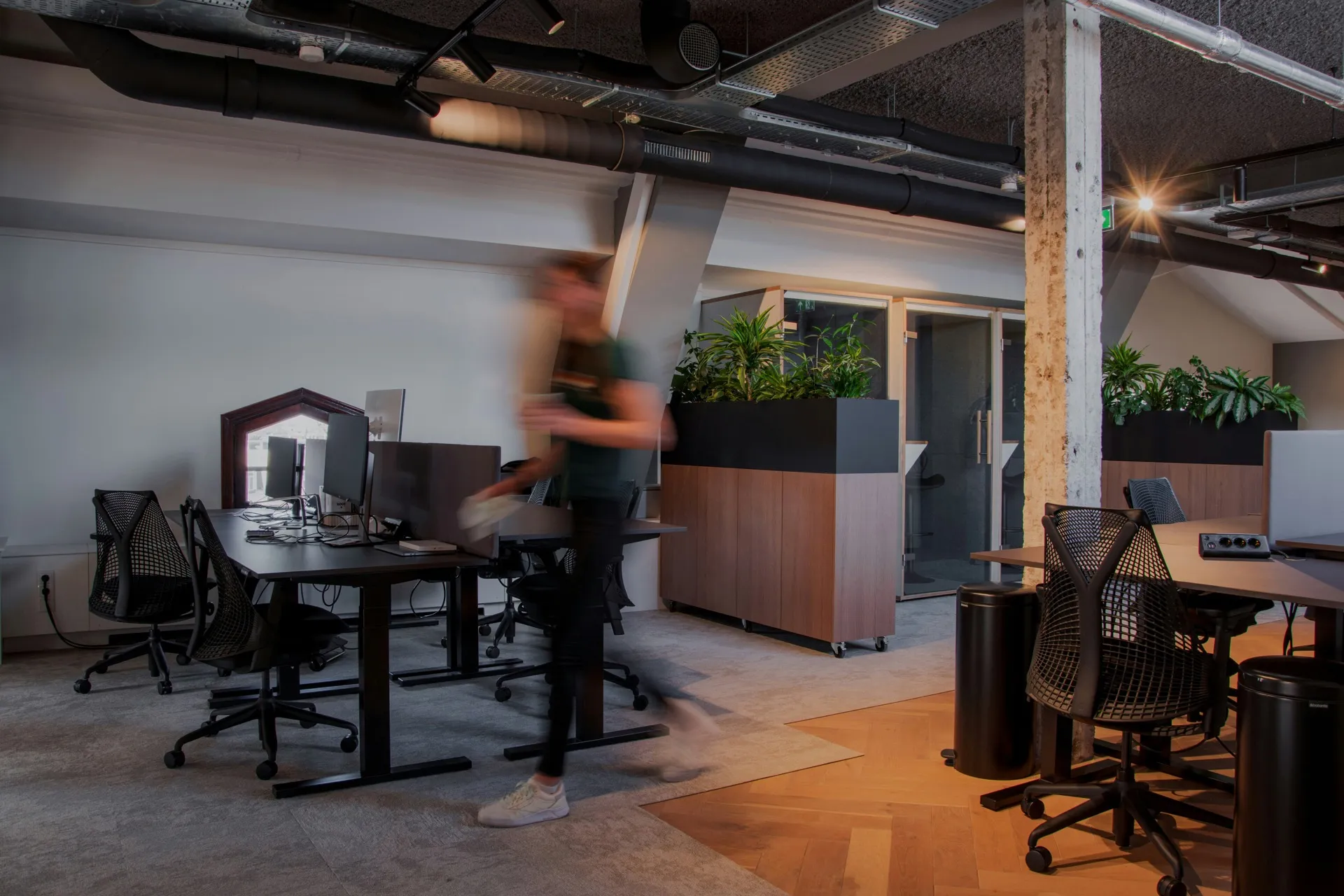
Workspace is the new cloud spend because a service-based model is taking the industry by storm. But the majority of companies are currently stuck in an in-between state. They're forced to pay for their legacy fixed office infrastructure because they're stuck in long leases, but they're operating in a highly variable and distributed professional world. This has given rise to a waste gap and a management vortex.
Let's unpack what financial waste looks like in that in-between territory. Real estate is usually the second-largest business expense after salaries, but much of it is drastically underutilized. If you're a 100-person company leasing 15,000 square feet at roughly $35 per square foot annually, your total real estate footprint costs $525,000 a year.
But if your average attendance is 50%, then 7,500 square feet of that is effectively 'ghost space' - empty desks that still come with full rent, tax, and utility costs. That's an eye-watering $262,500 annual leak in visible waste. Across industries, this "ghost space" drain often exceeds $300,000 per year, per company. It's a line item that simply doesn't make sense.
At this point in the cloud spend transition, "shadow IT" soared. Tools being purchased and used by employees didn't have central approval - creating hidden spend, fragmented usage, and significant security risk because no one has visibility or control. Unmanaged coworking today looks exactly like shadow IT did pre-cloud: spend without visibility, usage without insight. We're witnessing shadow workspaces.
We know distributed work is happening at scale. 28% of employees are now fully remote, while over 20% work hybrid, moving between environments throughout the week. But if they're not at home, and not in the office, then where are they? The answer is coworking spaces, third spaces, cafes, hotel lobbies, or neighborhood hubs.
This is the "shadow workspace", which might show up as travel or miscellaneous expenses, disconnected from any central system. For leadership, this means no clear understanding of where work is happening, no ability to track team proximity, and no governance over security. At the same time, employees lose time navigating this fragmented system, introducing cognitive overhead that compounds the financial waste.
The "cloudification" of the office has started, but the management layer hasn't arrived yet. As companies teeter on the edge of the workspace revolution, they're effectively paying twice. Once for offices that sit empty, and again for workspaces they don't track.
To survive this shift, workspace needs what computing already has: a centralized optimization layer that converts fragmented usage into actionable data and secure governance.
What's Driving Office-as-a-Service
The shift from "owning" to "accessing" workspace isn't just a financial preference; it's a structural response to a world that has outgrown the traditional lease. If the last decade was about the redistribution of data to the cloud, this decade is about the redistribution of workers into a demand-led office layer. So what's causing the shift?
Blended teams
Organizations are increasingly bringing together "liquid" talent. In 2026, 46% of the US labor force is freelance, embedded within a workforce of permanent staff, AI agents, contractors, and fractional leaders. A variable workforce doesn't need fixed space. For example, a major consulting group moved away from its single HQ to a network of on-demand hubs to solve the cultural friction of inviting high-value freelancers into a high-security corporate office environment they couldn't slot into seamlessly. They used a flexible workspace platform to build a neutral territory to remove the friction and overheads of guest-access protocols.
The mentorship gap
The shift to distributed work has exposed a growing mentorship gap. While established leaders often thrive in remote settings, the next generation is paying the price in lost development. To address this, innovative companies are using data to reconnect senior leaders with the junior talent supported by a flexible office layer. For instance, a telecommunications firm recently replaced three large regional offices with access to thousands of local coworking sites. Their platform now triggers a "proximity event" notification when a mentor and a junior engineer are within 10 miles of each other, suggesting a meeting at a local hub. They cut real estate costs by 80% while actually increasing weekly face-to-face mentorship hours.
AI and the collaboration premium
As AI automates routine cognitive tasks, the value of human labor shifts toward high-stakes creativity and complex problem-solving. The human workforce is becoming less tied up with production and more with innovation and validation, which calls for different kinds of offices. For example, a global software firm recently integrated AI "copilots" into its development cycle. While its coding speed doubled, teams that worked from home missed some critical errors. By moving to a distributed hub model for "sprint bursts," they used neutral, high-collaboration shared environments to unlock the communication and debate required to catch complex errors often missed when working in isolation.
Environmental compliance
Commuting is the single largest contributor to a worker's carbon footprint. In 2026, the cloudification of workspace has become a central lever for hitting net-zero commitments. For instance, a leading insurance firm shifted 25% of its workforce to a "local-first" workspace strategy to cut costs and carbon emissions in line with its ESG strategy. They mapped their workforce onto high-value coworking spaces close to home and reduced the average commute from 45 minutes to 12 minutes. They slashed their carbon footprint by 40% overnight and were able to reinvest the $150 million saved on office expenses into talent and environmental improvements in their local area.
The case for office-as-a-service is strong. So what's holding leaders back? The transition is currently being throttled by a sunk-cost bias, meaning organizations feel anchored to expensive, long-term leases. A governance vacuum means HR and Finance lack the centralized operating system needed to manage distributed spending. Then there's the legacy mindset. Just as IT leaders once feared that moving data off-site meant a loss of security and control, today's executives often equate "out of sight" with "out of work."
But leaders who still treat their offices as a static asset rather than a dynamic service stay stuck in a costly middle ground: paying for the infrastructure of the past while trying to compete in the reality of the future. So what does the new model look like?
How much of your real estate is ghost space - and how much of your distributed spend is shadow workspace?
Bring Croissant in to convert both into measurable, governed spend.

Defining the Future State: The Workspace Cloud Model
For CFOs, the new workspace model turns your physical office into a utility layer. The cloudification of the office transforms your corporate real estate from capital expenditure to operational expenditure, from rigid assets to a variable system for your physical footprint. So, what can we expect from the future of workspace?
Total visibility
You can't fix what you can't see. The workspace cloud will introduce a single system of record that tracks every dollar spent across HQs, home setups, and third spaces. By providing a real-time dashboard for your entire footprint, it eliminates financial blind spots and allows you to right-size your spend based on actual human behavior, not outdated headcount guesses.
Built-in governance
Employees working from unvetted cafes - the "shadow workspace" - comes with security and financial liability. But the new workspace layer bakes compliance directly into the platform. It ensures every location meets enterprise standards for networking and physical security, creating an automated audit trail that proves your distributed team is as secure as they were behind HQ's corporate firewall.
On-demand scalability
The era of the 10-year lease gamble is over. In the cloud model, workspace is allocated like computing power: you'll pay only for the capacity you use, exactly when you need it. This gives you the freedom to scale your team up or down instantly, access immediate office overflow, or close down capacity that isn't being used.
ROI optimization
The ultimate goal isn't just saving money, it's growing human output. The future of workspace-as-a-service could use proximity data to suggest when and where teams should meet to hit their goals. It shifts the office from a "passive cost" to an "active tool" that engineers collaboration, drives project velocity, and recovers the productivity losses proven to come from unmanaged remote work.
Frictionless go-lives
A key feature of the workspace cloud is the removal of procurement lag. Instead of negotiating individual contracts for every new city or team, a unified network offers "single sign-on" style access to thousands of desks globally. The office can follow the talent, allowing you to activate a new market or support a remote team instantly without a single new lease or vendor relationship.
Ultimately, this is a move from buying buildings to buying outcomes. Just as the cloud spend revolution killed the need for server rooms, the workspace transformation will kill the long-term fixed lease. This isn't just a real estate move - it's the last step in the transition of the corporate balance sheet from rigid, depreciating assets to a variable cost model.
Turn your office from a passive cost into an active tool
The workspace cloud model is here. Croissant gives you a single platform for visibility, governance, on-demand scalability, and ROI-driven workspace decisions across every location your teams need.
Conclusion: Cloudification Becomes Competitive
The computing revolution of the early 2000s hands us a powerful blueprint for the office revolution of the 2020s. It's time to take note.
Like computing, software will go from being a cost to be minimized on the balance sheet to a resource to be optimized.
The upsides speak for themselves. By eliminating "ghost space," major enterprises have slashed real estate costs by up to 80%, liberating hundreds of millions in capital to reinvest in talent and R&D. But the talent impact is where the long-term ROI sits. Transitioning to managed, flexible environments has been shown to lower turnover by 26%, while data-driven proximity ensures that onboarding and high-stakes collaboration don't wither in isolation. Considering the global economy loses $10 trillion annually to disengagement, fixing the "where" and "how" of work isn't cosmetic; it's structural.
So the companies that win in 2026 won't be the ones that spend the least on workspace. They'll be the ones that spend it best: allocating space exactly where and when it creates the most value.
The frontrunners will look at their office footprint the same way they look at their software stack. They'll recognize that a long-term lease is the same as on-premises hardware: expensive, rigid, and impossible to scale.
So just as the most successful tech companies no longer build their own data centers but sit on vast computing power, the most successful organizations will no longer own vast desk space - just the power and capability to deploy space instantly as needed.
Twenty years ago, we stopped buying servers and started deploying from the cloud - and IT never looked back. The same shift is coming for the office. Away from the burden of a building and toward the power of a flexible network. The age of the office as a place you "go" is over; the age of the office as a service you deploy has begun.
Get in touch today to explore how Croissant can support you to "cloudify" your workspace offer.
Build Your Workspace Cloud With Croissant
Stop paying twice for ghost space and shadow workspaces. Croissant is the workspace cloud layer that converts fragmented usage into actionable data, secure governance, and on-demand scalability for distributed teams.
- ✓ Activate on-demand workspace across 800+ locations without a single new lease
- ✓ Get one system of record for every workspace dollar across HQs, home, and third spaces
- ✓ Apply governance, security, and policy controls to a fully distributed workforce